

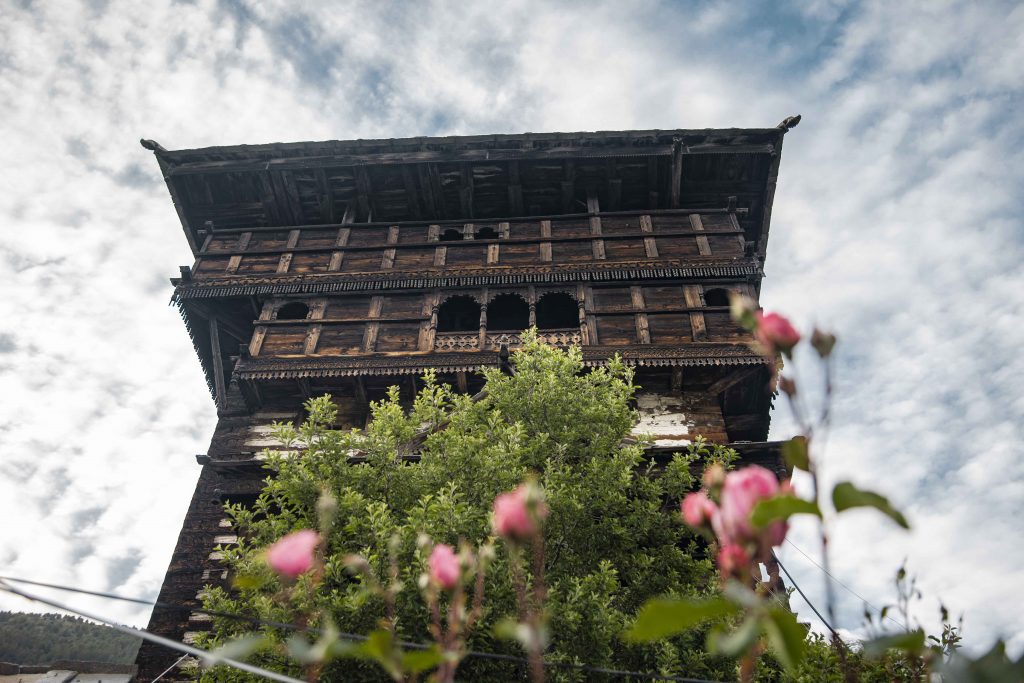
There is a fort in Sangla Valley that most travellers walk past without realising what it is. It sits above the village of Kamru — just two kilometres from the main town — a dark, tiered wooden tower rising against a ridge of deodar trees, with the sacred pyramid of Kinner Kailash floating above it on clear mornings. It looks like something from a dream you once had about the Himalayas.
Kamru Fort is one of the oldest and most significant historical structures in Kinnaur, a district already rich with ancient sites. Built somewhere between the 8th and 15th centuries (historians still debate the exact origins), the fort served as the seat of the Bushahr royal family before they moved their capital to Rampur. Today it functions as a living temple — dedicated to the goddess Kamakhya Devi — and draws a quiet stream of devotees, historians, and curious travellers who somehow find their way up the hill.
This guide tells you everything worth knowing before you visit: the history, the architecture, what to expect inside, how to get there, and the small cultural details that will help you experience the fort respectfully and fully.
The History of Kamru Fort
The fort’s origins are intertwined with the rise of the Bushahr Kingdom, one of the most powerful hill states in the western Himalayas during the medieval period. The Bushahr rulers — known for their fierce independence and sophisticated trade networks along the old Indo-Tibetan salt routes — used Kamru as both a strategic stronghold and a centre of religious authority.
The fort’s name itself comes from the Kamakhya Devi temple housed within it, which is connected to the Kamakhya temple complex in Assam — one of the most important Shakti shrines in all of India. The presence of this temple in a remote Himalayan valley speaks to the remarkable cultural and religious connections that existed across the subcontinent centuries before modern roads.
During its peak, Kamru Fort controlled movement along the Baspa Valley and the trade routes that connected Kinnaur to Tibet. Spices, wool, borax, and salt flowed through these mountains, and the Bushahr kingdom exacted taxes and provided protection along these ancient corridors. The fort was simultaneously a military post, a royal residence, a trading checkpoint, and a sacred site — a combination that was entirely typical of Himalayan hill states.
💡The British colonial records on Kamru Fort are surprisingly detailed. If you’re a history enthusiast, the Himachal Pradesh State Archives in Shimla holds survey documents from the 1800s that describe the fort and its surroundings.
The Architecture: Wood, Stone & Mountain Genius
What immediately strikes you about Kamru Fort is how different it looks from the stone forts of Rajasthan or the Mughal complexes of the plains. Himalayan fort architecture developed its own distinct vocabulary — one shaped by the materials available (primarily deodar cedar wood and local slate), the seismic activity of mountain regions, and the aesthetic traditions of communities that existed at the intersection of South Asian, Tibetan, and Central Asian influences.
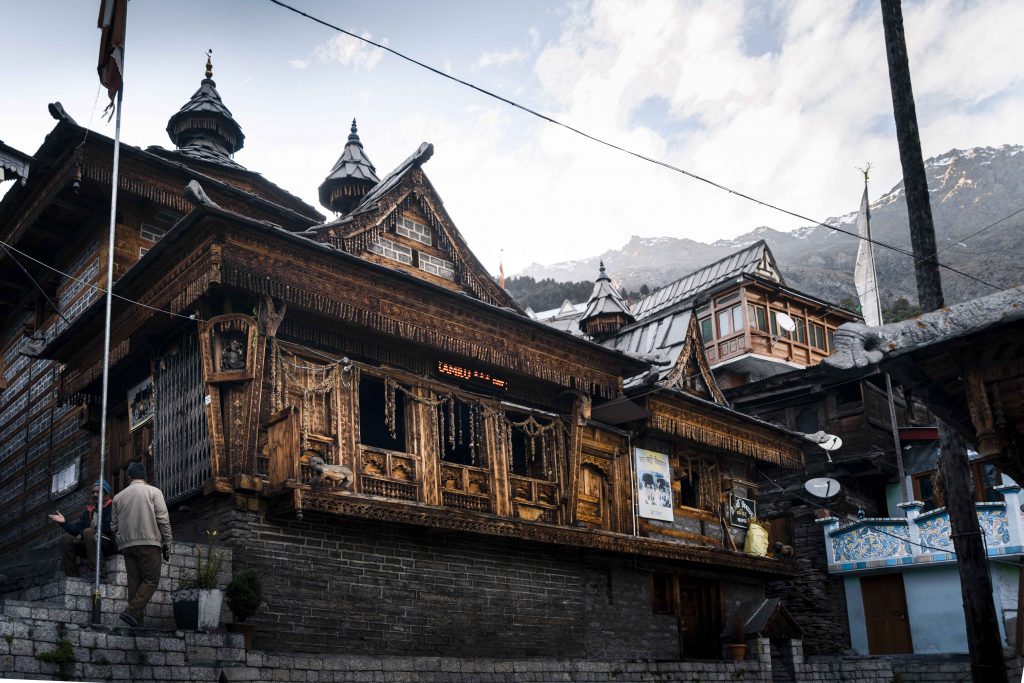
The fort is built in the traditional Kath-Kuni style — alternating layers of deodar wood beams and dry stone masonry, without mortar. This technique, used throughout Kinnaur and Himachal Pradesh, creates structures that are remarkably earthquake-resistant; the interlocking timber framework absorbs seismic movement rather than cracking under it. The walls are thick, the windows are small and deep-set, and the wooden carvings on the facade show an extraordinary level of craftsmanship — intricate geometric patterns, deity figures, and floral motifs that have survived centuries of Himalayan winters.
The fort rises in three distinct tiers. The lower levels once served as storerooms and garrison quarters; the middle section housed the royal apartments; and the uppermost level holds the Kamakhya Devi temple, which is the spiritual heart of the structure. A small statue of the Buddhist bodhisattva is also present in the complex — a reminder that Kinnaur has historically sat at the boundary between Hindu and Tibetan Buddhist traditions, absorbing elements of both.
Visiting Kamru Fort: Timings, Entry & What to Expect
| 📋 Quick Reference: Kamru Fort Open: Daily, approximately 8:00 AM – 6:00 PM (temple hours may vary by season) Entry Fee: No fixed fee; small donation welcomed at the temple Time needed: 45 minutes to 1.5 hours Distance from Sangla town: ~2 km (10-minute drive or 25-minute walk) |
The walk up to the fort from Kamru village is short but steep — around 15 minutes on a stone-paved path that winds through the village and then up through deodar trees. The path is well-marked and manageable for most fitness levels, though the altitude (around 2,800 metres at the fort) means you’ll feel the incline more than you’d expect.
As you approach the gate, you’ll notice a sign requesting that visitors remove leather items — belts, leather wallets, leather shoes — before entering the temple precincts. This is a deeply held local tradition and should be observed without exception. Most visitors carry a small bag to store these items at the entrance. Wear non-leather footwear if you plan to enter the inner temple.
Inside, a local priest or caretaker will often guide you through the main shrine. The Kamakhya Devi idol is housed in a small, dimly lit inner sanctum — allow your eyes to adjust and take a moment to appreciate the atmosphere. Photography is restricted inside the inner temple; always ask before pointing a camera.
💡Visit early morning if you want Kinner Kailash visible from the fort’s upper terrace. By 11am, clouds typically begin to gather around the peak and the view disappears. The morning light on the wooden carvings is also extraordinary for photography.
How to Reach Kamru Fort from Sangla
Kamru village sits approximately 2 kilometres from Sangla town, on the opposite side of the valley from the main road. There are two ways to get there:
On foot:
From Sangla town, cross the bridge over the Baspa River and follow the signs toward Kamru village. The entire walk takes 20–30 minutes on a flat road, followed by the 15-minute climb up to the fort. It’s a pleasant morning walk with good views of the valley.
By vehicle:
Any local taxi or auto-rickshaw from Sangla town will drop you at the base of Kamru village for a small fare. If you’re driving, there is limited parking at the village edge. Most camps and guesthouses in the area can arrange a drop-off.
💡Combine Kamru Fort with Rakcham village (17 km further toward Chitkul) in a single morning outing. Leave at 7am, visit the fort, then drive up-valley for lunch at a Rakcham dhaba before heading to Chitkul.
Cultural Etiquette: How to Visit Respectfully
Kamru Fort is not a museum — it is an active place of worship visited by local devotees every day. The way you conduct yourself there matters, both for the sanctity of the site and for the impression travellers leave in a community that is only slowly opening itself to tourism.
- Remove leather items at the entrance gate — this includes belts, wallets, leather sandals, and leather watch straps. Non-leather footwear (sports shoes, sandals with fabric or rubber) is fine.
- Dress modestly. Shorts and sleeveless tops are inappropriate inside the temple precinct. Carry a light shawl or layer if you’re unsure — Himalayan mornings are cool anyway.
- Keep your voice low inside the inner sanctum. The small size of the temple means that noise carries and disturbs other visitors and worshippers.
- Ask before photographing people — particularly priests, elderly devotees, and local families. A smile and a gesture go a long way.
- Make a small donation at the temple. There is no fixed entry fee, but the fort is maintained by the local community and contributions are appreciated and appropriate.
Locals in Kamru are genuinely warm toward respectful travellers. If the caretaker or a local resident offers to show you around or explain the history, accept — the stories you’ll hear about the Bushahr kingdom and the temple’s traditions are far richer than anything a guidebook can offer.
Best Time to Visit Kamru Fort
The fort is accessible year-round, though the experience varies significantly by season.
May to June brings clear skies and the best chance of seeing Kinner Kailash from the fort’s terrace. The apple blossoms are out, the valley is green and fresh, and the light is beautiful for photography.
July and August (monsoon) drapes everything in mist. The fort takes on an atmospheric, almost mystical quality in low cloud — but the path up can be slippery after rain, so wear grip shoes. The inner carvings and architecture are actually easier to photograph in diffuse monsoon light, without harsh shadows.
September and October is the finest overall window. Clear skies return, the apple harvest turns the orchards golden, and the crowds thin out after the summer season. Kinner Kailash dusted with early snow against the wooden fort architecture is one of the most beautiful sights in Himachal Pradesh.
November to March sees the village quiet down and the upper paths sometimes icy. The fort remains accessible on most days, but check local conditions before heading up.
💡Kamru Fort is most magical at the bookends of the day. Sunrise visits (if you can arrange access) offer extraordinary light and complete solitude. Evening visits, when the last light catches the wooden carvings, are equally special — but leave before dark.
A Note on Staying Close to Kamru Fort
The fort that gave Kamru Riverside Camps & Resorts its name sits close enough that you can see the ridge it stands on from our camp — and walking up at first light, before the valley wakes, is one of the experiences we recommend to every guest. When you’re staying beside the Baspa River, Kamru Fort isn’t an excursion. It’s simply part of the morning.


